Table of Contents
Chloroplast Definition
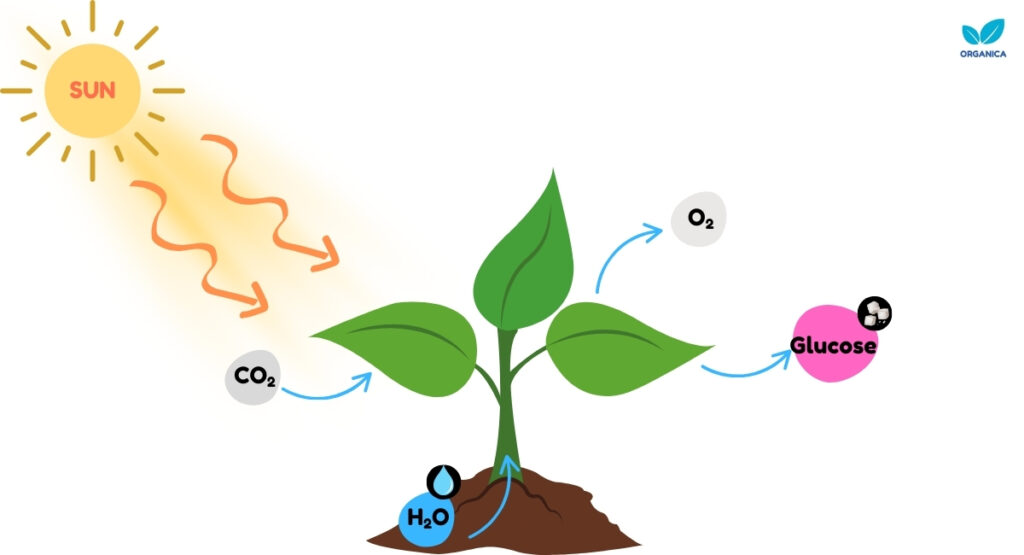
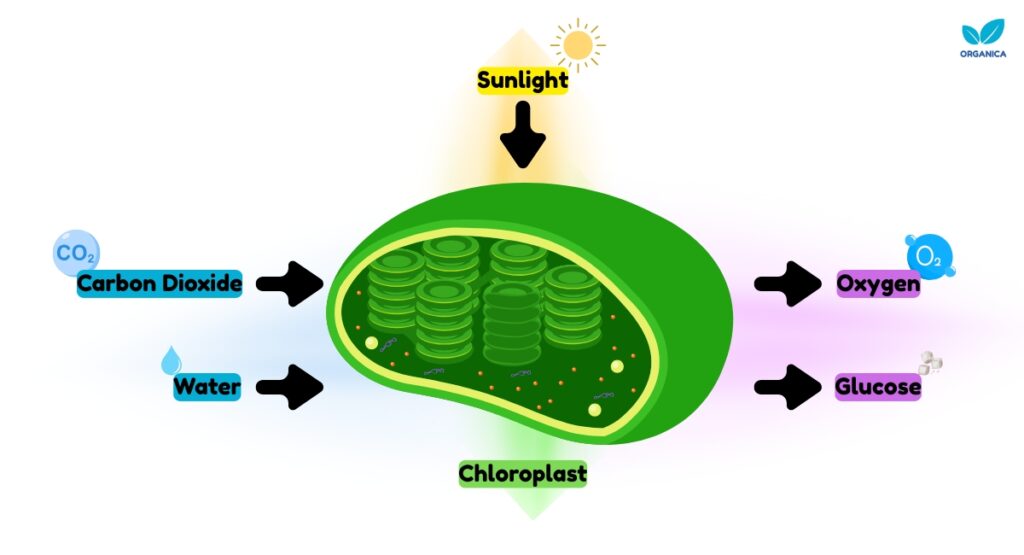
Photosynthesis is a very crucial process that occurs in plants. It involves the making of food (glucose) from raw materials using energy from sunlight. However, photosynthesis alone will not be possible if a special organelle, called chloroplast, did not exist in plant cells.
The chloroplast function explains the role of the plant. It houses chlorophyll, the green pigment responsible for photosynthesis in plant cells, particularly in palisade mesophyll cells and spongy mesophyll cells.
Each plant cell can have multiple chloroplasts.
Chloroplast Structure
A chloroplast is a double-membrane organelle found in plant cells. Its outer membrane and inner membrane control the movement of substances in and out of the organelle.
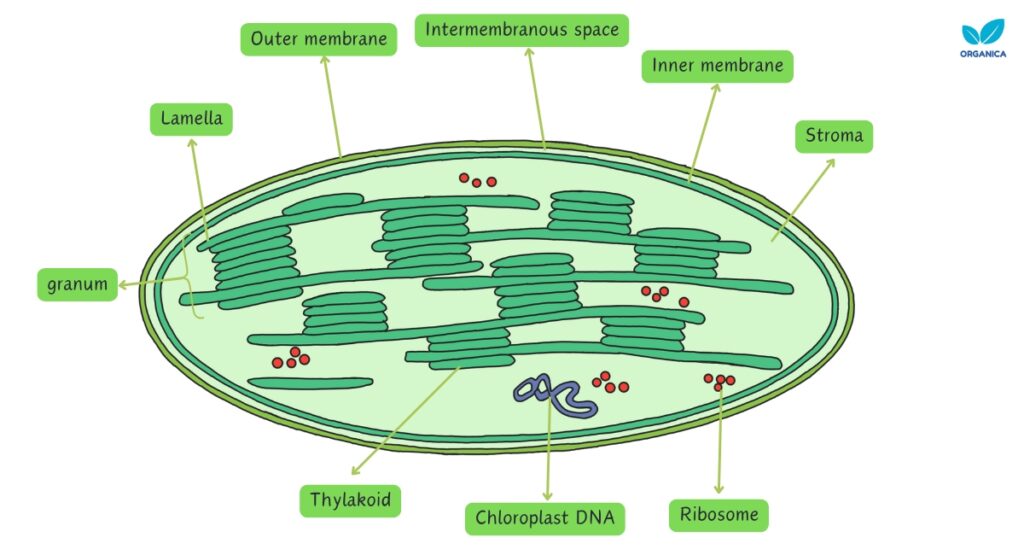
Inside this envelope lies the stroma, a watery substance that contains enzymes essential for photosynthesis. The stroma also houses 70s ribosomes and circular DNA for photosynthesis.
Suspended within the stroma are the coin-shaped thylakoids. These fluid-filled sacs are surrounded by the thylakoid membrane. In some areas, thylakoid stacks like coins, forming a granum. Grana, the plural form of granum, are connected through flat membrane extensions called lamellae.
The membranes of both lamellae and thylakoids contain photosynthetic pigments that function similarly to those found in the electron transport chain in the mitochondria. These pigments absorb light energy to create an electrochemical gradient, releasing energy in the form of ATP.
Plants use many photosynthetic pigments, but the main ones are chlorophyll a and chlorophyll b. Other, less common pigments include carotene and xanthophyll. The colour of each pigment is due to the wavelength it reflects, while it absorbs other wavelengths to capture light energy. For example, chlorophyll appears green because it absorbs red light and reflects green.
| Photosynthetic pigment | Leaves colour |
| Chlorophyll a | dark green |
| Chlorophyll b | yellow-green |
| Carotene | yellow-orange |
| Xanthophyll | yellow |
In the table above, we have discussed the colours that pigments reflect. So what about the ones they absorb? Each pigment absorbs light energy best at specific wavelengths. Going above or below their optimum wavelength can slow down photosynthesis. The following table shows the absorption wavelength of the four pigments.
| Photosynthetic pigment | Wavelength |
| Chlorophyll a | blue-violet (~430nm) red (~662nm) |
| Chlorophyll b | blue-violet (~453-455nm) orange-red (~642-644nm) |
| Carotene | blue-green (~400-500nm) |
| Xanthophyll | blue-green (~400-500nm) |
Plants use multiple pigments to help capture more sunlight than a single pigment. This provides a wider range of absorption and a higher rate of photosynthesis at different wavelengths. These pigments form clusters called photosystems in the membrane of the thylakoid.
Each photosystem contains many pigments and proteins. Pigments absorb light and direct energy to a reaction centre. Photosystem I absorbs light at 700 nm, while photosystem II absorbs at 650 nm.
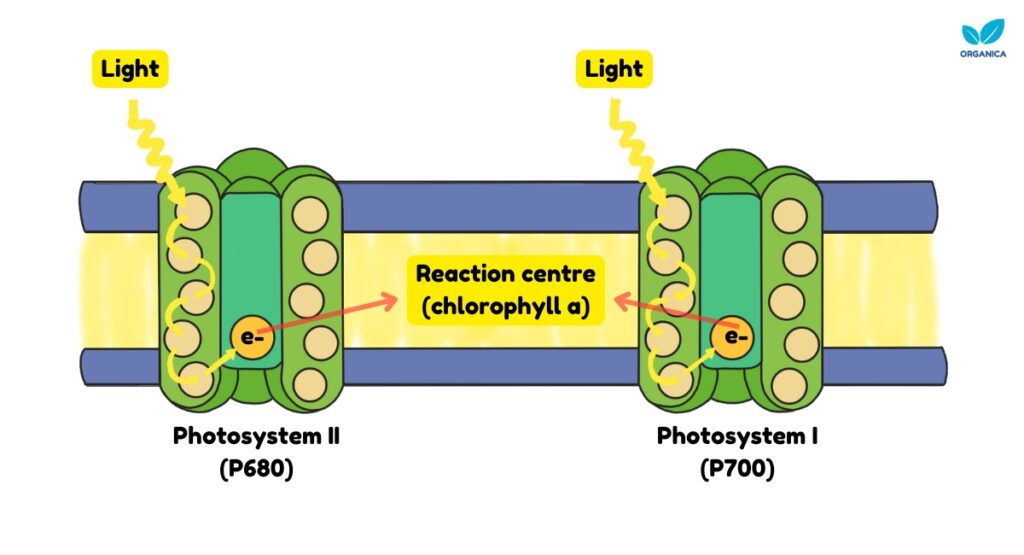
Both photosystems have two chlorophyll a molecules in their reaction centers. Other pigments (chlorophyll b, carotene, xanthophyll) act as energy-harvesting molecules to collect and transfer light energy to chlorophyll a.
Evolution
Scientists believe that chloroplasts have evolved through a process called endosymbiosis. A prokaryote was engulfed by an early eukaryotic cell. Instead of digesting it, the prokaryote lived inside the host cell and provided it with sugar made from photosynthesis.
Over time, this relationship became permanent, and the engulfed prokaryote lost its independence, turning into the modern chloroplast.
Chloroplast and Mitochondria
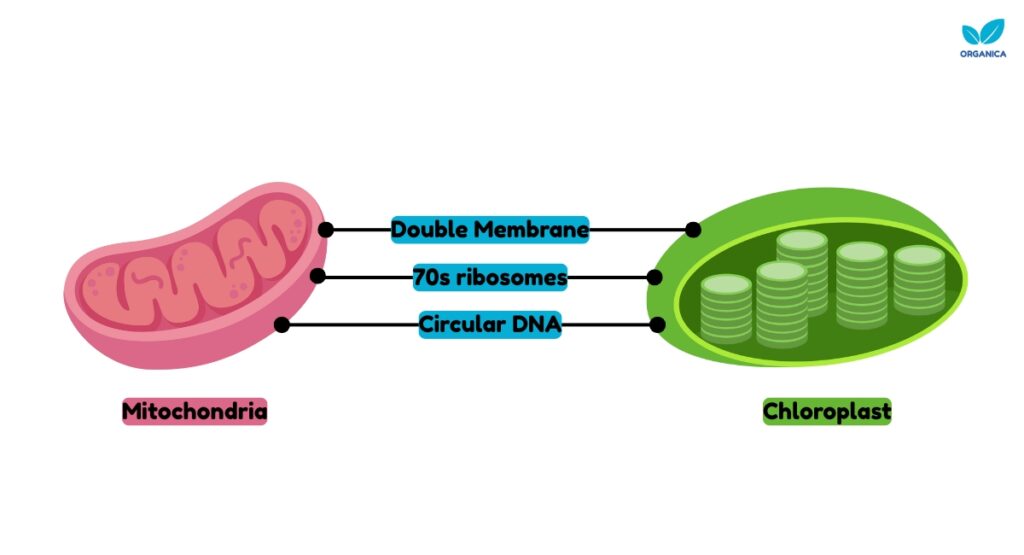
Chloroplasts and mitochondria share an interesting relationship. This relationship forms the fundamental block for life as we know it today. The products of one organelle are the reactants of the other. They both have a double membrane, contain circular DNA and ribosomes that allow them to make their own proteins, and play an essential role in cells.