Table of Contents
Pyruvate Definition
Pyruvate oxidation is considered a key step in cellular respiration.
Pyruvate is a three-carbon molecule produced during Glycolysis and plays a major role in cellular respiration and ATP synthesis.

Pyruvate oxidation
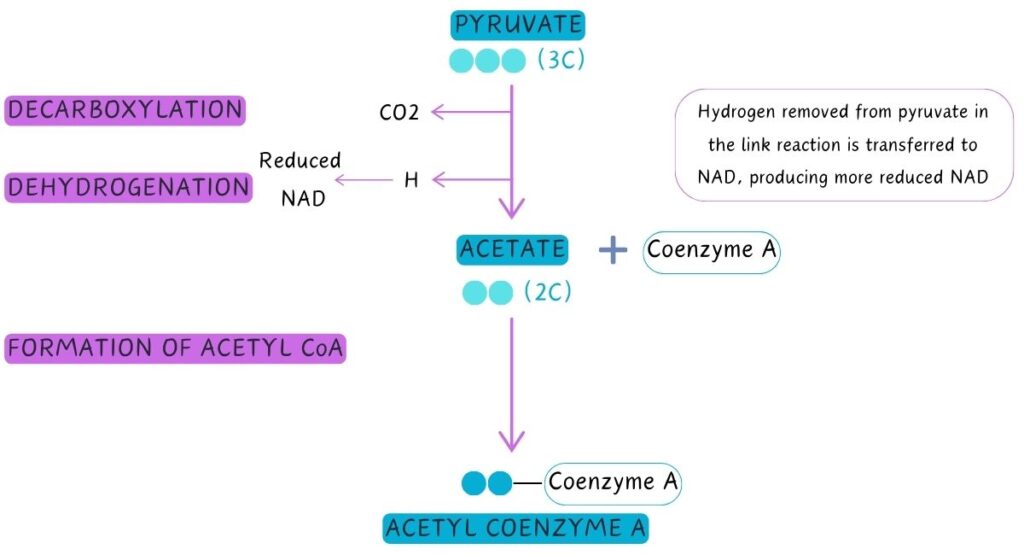
The purpose of oxidising pyruvate is to link the process of Glycolysis with the Krebs cycle. Once pyruvate enters the matrix of the mitochondria, the powerhouse of the cell, the enzyme “pyruvate decarboxylase” removes a molecule of carbon dioxide, forming a two-carbon intermediate known as acetate. The removal of a carbon dioxide molecule from another molecule is called decarboxylation.
As this occurs, another enzyme, called “pyruvate oxidase”, removes one hydrogen ion, which NAD+ picks up to form NADH. NADH will later be used to create an electrochemical gradient in the electron transport chain stage.
A coenzyme is a complex molecule that helps an enzyme catalyse a reaction. In this case, coenzyme A is used to carry and supply an acetyl group to the two-carbon acetate. The final product is called “acetyl-Coenzyme A”, shortly known as “acetyl-CoA”.
Coenzyme A is made up of Adenine, ribose, and vitamin B5 (pantothenic acid).